


David Wendel, managing director at ETS Degassing, looks at how mobile emission reduction enhances sustainability and improves safety in operations

David Wendel, managing director, ETS Degassing
Faced with decarbonisation, industrial plants across all sectors meet significant challenges and the need to balance operational efficiency with environmental responsibility. Reducing emissions, modernising infrastructures, implementing new technologies and adapting to evolving compliance standards have become pressing concerns for many industries.
The tank storage sector is no exception and faces challenges of enhancing sustainability and reducing the emission of pollutants as well. Mobile degassing and replacement services can support the operators of tank terminals and storage facilities in establishing more sustainable processes by effectively and environmentally-friendly treating developing gases and vapours.
Compliance With Standards And Regulations
Meeting environmental standards and regulations while maintaining operational efficiency can be a difficult task for operators in the tank storage industry. VOC (volatile organic compound) or HAP (hazardous air pollutant) emissions are often released during storage, transfer or maintenance processes. If left untreated, these precursors of greenhouse gas (GHG) emissions contribute to air pollution and also pose risks to the health and safety of employees as well as surrounding neighbourhoods. Emission treatment of gases and vapours that develop in tank terminals and storage facilities is therefore very important. Equally relevant is treating residual gases that often settle and remain in tanks or pipes. Without proper treatments, residual gases can also significantly impact air quality and human health.
Managing VOC and HAP emissions from storage tanks, pipelines and terminal operations has become a critical priority. The effective treatment of residual gases is essential to reducing the environmental impact, instead of releasing them directly into the atmosphere. In recent years, there has been a growing awareness for sustainable industrial processes. As part of decarbonisation and the mitigation of the global carbon footprint, the emission of gases with a high global warming potential (GWP) needs to be reduced.
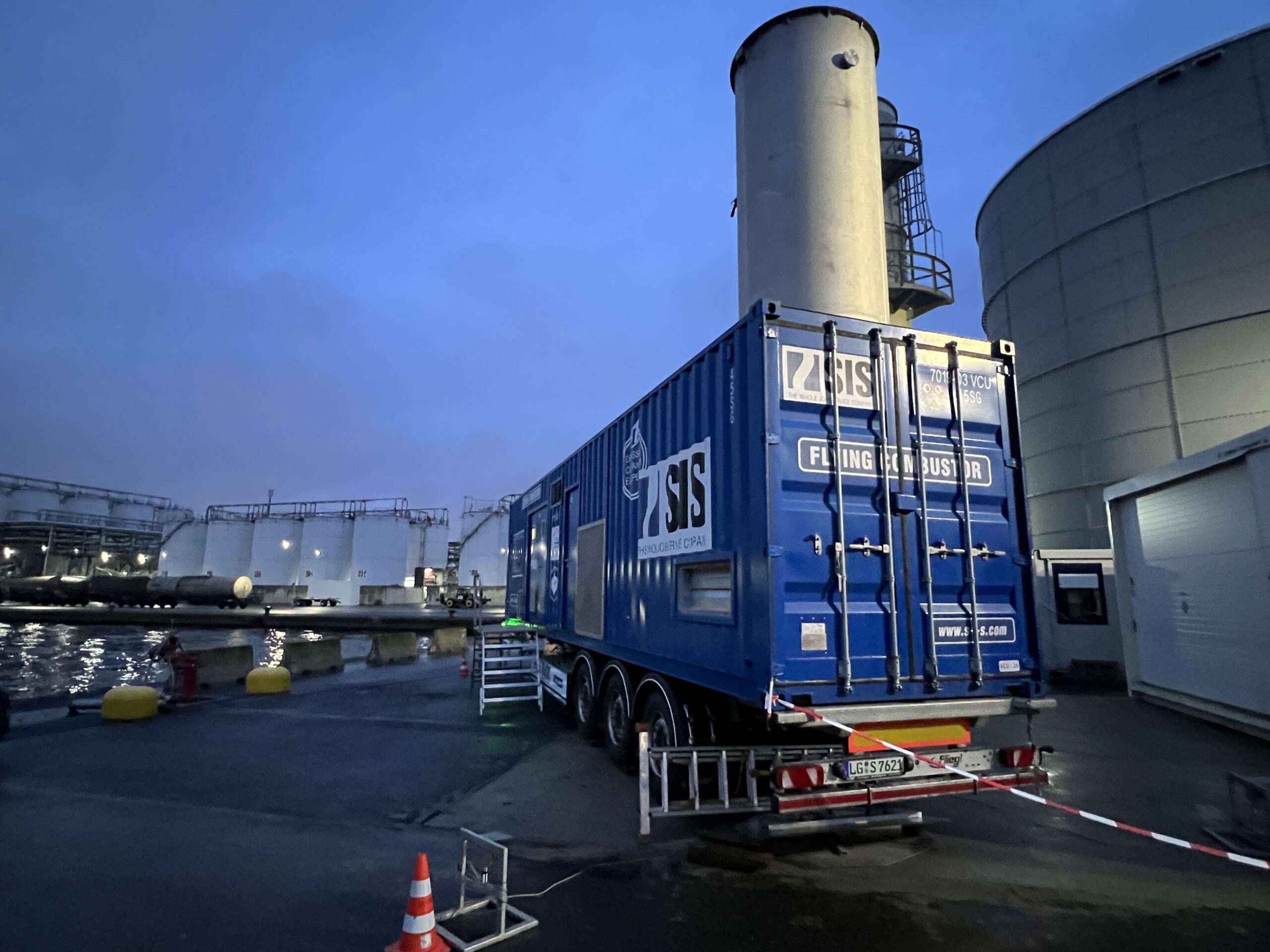
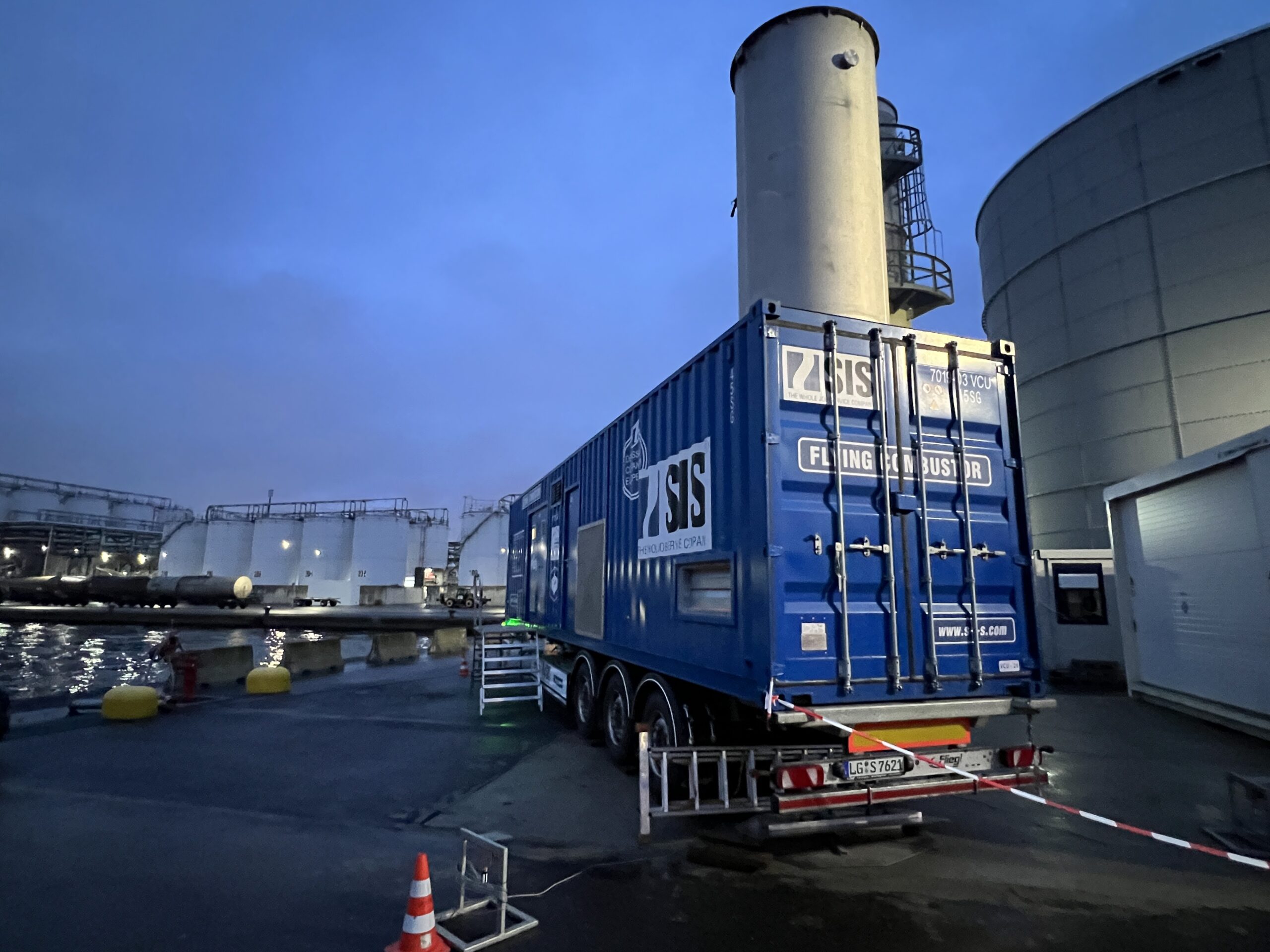
Mobile vapour combustion unit during a VRU replacement application in the Port of Antwerp, Belgium
Flexible And Sustainable Emission Treatment
Mobile degassing and replacement services support operators of industrial plants from different sectors in efficiently and sustainably treating their emissions – from tank terminals and refineries
to ports, chemical plants, industrial services and other markets. For ETS Degassing, the key for supporting customers in emission treatment for different applications are the team’s innovative mobile vapour combustion units (VCUs) that destroy all kinds of gases, gas mixtures and vapours from explosion groups IIA, IIB and IIC – from gaseous hydrocarbons to organic solvents and hydrogen-containing vapours.
During the emission treatment process, the units destroy the hazardous pollutants by combustion, with an efficiency of over 99.99%. As neither open flame, odour nor noise result from this, the emission treatment process is particularly safe and sustainable. The mobile vapour combustion units are transportable as trailers or containers and can be flexibly deployed directly where emissions and pollutants develop – on-site in tank terminals, storage facilities, plants or refineries.
With piping networks, the mobile VCU is connected to the component containing the residual gases to be treated. The pollutants are separated and then destroyed by combusting. By thermally treating and combusting the captured gases in the mobile incinerator, the emission of pollutants is minimised, and emissions are reduced to a significantly lower, environmentally-friendly level. For example, ETS Degassing recently applied a mobile VCU to treat emissions from an LNG fuel tank with a volume of 1,280 m³. Normally, the GWP factor of the LNG is 60.87 tons (55 tonnes), assuming a CO2eq/kg of 36 kg. By treating the developing emissions and combusting the residual gases, the CO2eq factor was reduced to just 6.64 tons – representing a total reduction of 89%.
Mobile Degassing For A Safe Treatment Of Residual And Exhaust Gases
The main application of mobile vapour combustion units is the degassing of tanks, pipelines, ships and inland barges – for example for commissioning, decommissioning, loading and unloading procedures or in preparation of product changes, cleaning, maintenance and repair works. In recent projects, we have for example carried out the degassing of tanks containing crude oil, propane, petrol, propylene oxide, butane, naphtha, benzol and cyclohexane for tank terminals and storage facilities in Germany, the United Kingdom, Austria, Belgium, France and the Netherlands. In addition, ETS applies its European patent for the degassing of vacuum trucks.
In the Port of Duisburg, Germany, ETS Degassing established the first legal and environmentally-friendly degassing option for inland barges and vessels on the River Rhine in Germany. Barges, vessels, gas tankers and motor tankers can sustainably dispose of residual gases at its degassing site to prepare for safe product changes or shipyard works. The site is permanently equipped with a mobile VCU for degassing, and a mobile.
As LNG is becoming increasingly important as an alternative energy source, there has also been a rising demand for LNG cool-down operations and LNG fuel tank degassing. For example, ETS recently carried out a major application for a big ship in the Port of Rotterdam, Netherlands. The team was given short notice one evening, and ETS’ units and operators were already on site the following morning. By noon, the operation had begun, and was completed by the next night. For the LNG cool down, ETS Degassing applied a mobile vapour combustion unit and a mobile nitrogen vaporiser to add nitrogen to the tank. For different application in the Netherlands, ETS provided a mobile VCU and the nitrogen vaporiser for the degassing of LNG fuel tanks on board a tanker.
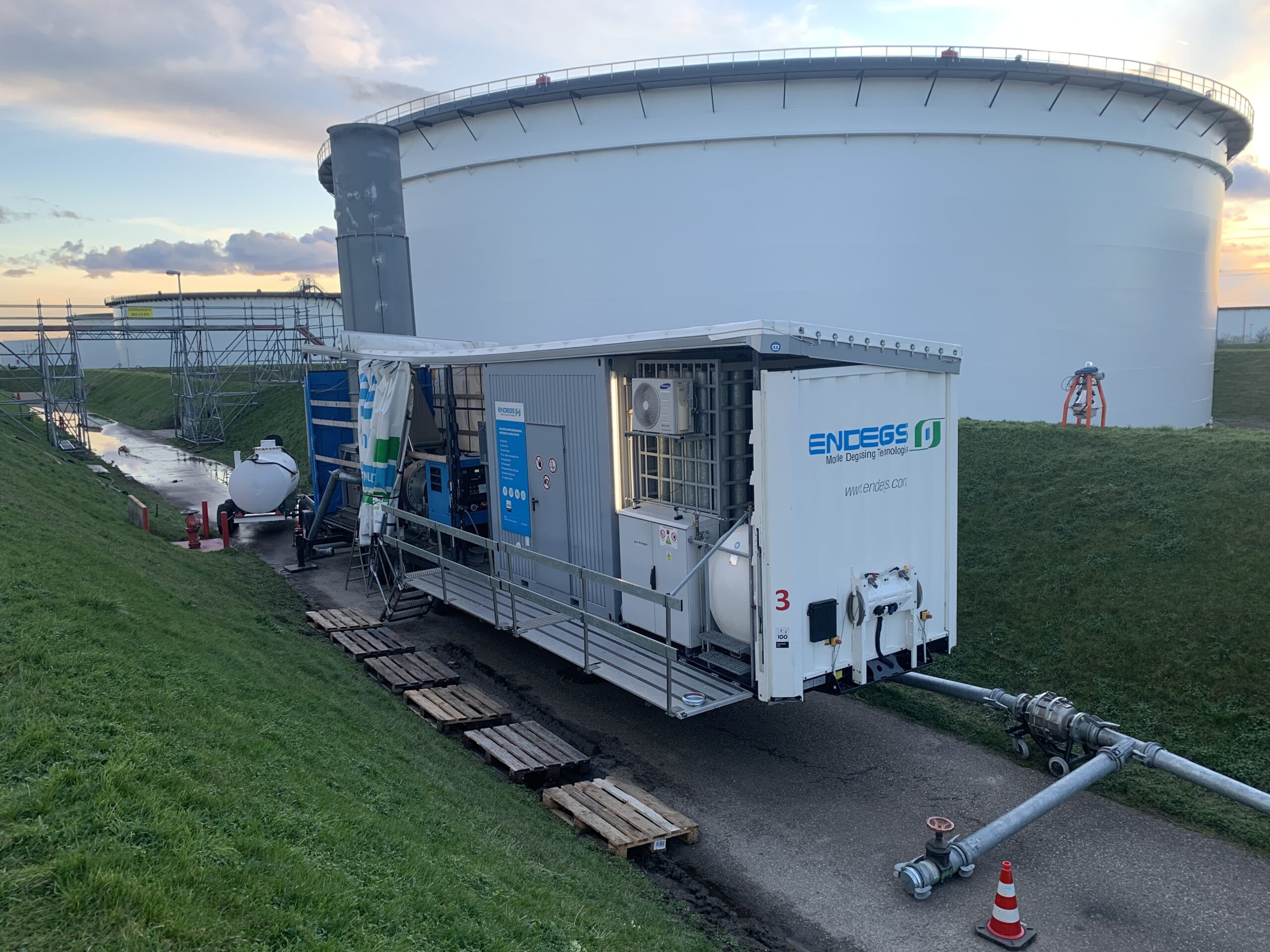
Mobile vapour combustion unit during the degassing of a storage tank and vacuum truck in the Netherlands
Temporary VRU Replacement
Mobile vapour combustion units can also be used to temporarily replace stationary emission reduction systems such as vapour recovery units (VRUs) during downtime due to maintenance or repair. Facilities without a VRU are not allowed to operate, but applying a VCU ensures emissions are treated, avoiding downtime or shutdowns. Recent applications, for example, include replacement services in tank terminals in Germany and the Netherlands or during ship loadings in the Ports of Antwerp, Rotterdam and Amsterdam. ETS Degassing has also replaced a VRU in a truck loading facility in the Netherlands, ensuring that the loading operations could be continued without interference.
Safety First
ETS Degassing was recently awarded a TotalEnergies Safety Award in the category of Safest Contractor Tank Terminal for two VRU replacement deployments. In two tank terminals, the stationary VRUs had to be taken out of operation for repair. For the duration of the VRU downtimes, ETS’ mobile VCUs combusted the developing vapours and gases to continue emission treatment and avoid safety risks or environmental damages. Thus, the operations in the tank terminals could be maintained safely and without restrictions, ensuring that no petrol shortages occurred in the affected regions. ETS’ on-site operators worked closely together with the customer to ensure smooth processes during the VRU back-up.
By implementing environmental technologies such as mobile degassing, VRU replacement and emission treatment, industrial plants and tank storage facilities can align operations with sustainability and safety goals, reducing their environmental footprint. As technologies evolve, emission treatment remains an indispensable tool for driving progress and supporting decarbonisation efforts across the industry.