

GrandPersepctive’s Simon Bunegar explains how Shell Moerdijk is making award-winning process safety even better
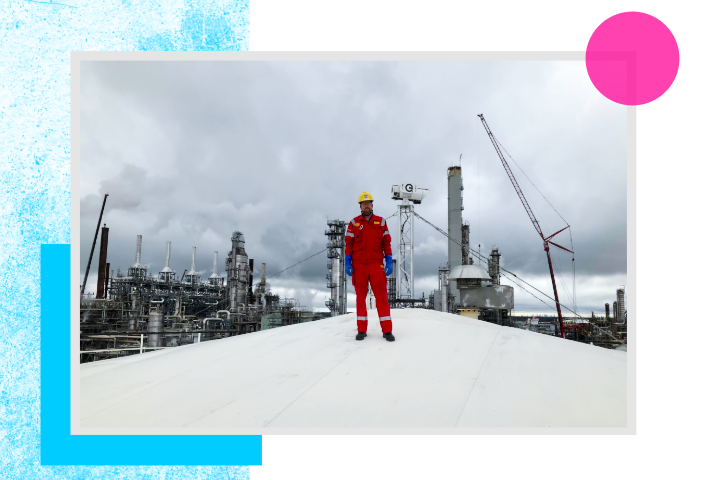
When people think of Europe’s largest petrochemical facilities, they often imagine sprawling infrastructure, vast networks of pipelines, towering distillation columns, and the sheer scale of production that powers everything from plastics to packaging. This can only happen when safety sits firmly at the heart of operations.
Thanks to major infrastructure upgrades and a world-class safety culture, which has become deeply ingrained in the DNA of every employee and contractor, Shell Moerdijk is learning from incidents to cement its reputation as one of the most sustainable and secure chemical production facilities on the continent.
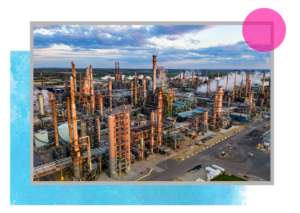
Built in the late 1960s, the plant is now home to some of the most advanced safety technology found anywhere in the world. Because of this it has grown into one of Europe’s biggest and most sophisticated chemical parks. Producing a diverse portfolio of essential industrial chemicals – including styrene, ethylene, ethylbenzene, propylene, benzene, ethylene oxide and propylene oxide – the plant employs around 850 people, while also providing work for more than 400 contractors each day. Spanning some 320-hectares, an area large enough to house more than 800 football pitches, Shell Moerdijk has a production capacity of around 4.5 million tonnes of chemicals, which are supplied to and from the site by ship, rail, road, and pipeline.
This scale alone brings extraordinary responsibilities. ‘For the staff and contractors who work here, prioritising health, security, safety and the environment is at the heart of everything we do,’ explains Eric van der Sluis, a senior HSE professional, who heads Shell’s digitalisation team at Moerdijk. ‘It is a culture that is deeply inculcated in the minds and actions of every employee.’
Safety culture, however, cannot stand still. It must evolve to meet the challenges of new technologies, stricter environmental requirements, and the needs of the thousands of people who live in close proximity to the site.
Watching Every Valve ‘Round the Clock
At the core of the facility’s process safety framework lies an intensive regime of monitoring and surveillance. Strategically-placed fixed-point sensors track potential leaks near high-risk equipment such as pumps and compressors. Alongside the sensors, highly trained operators perform daily operational rounds in medium and high-risk areas, inspecting for signs of leaks or irregularities. 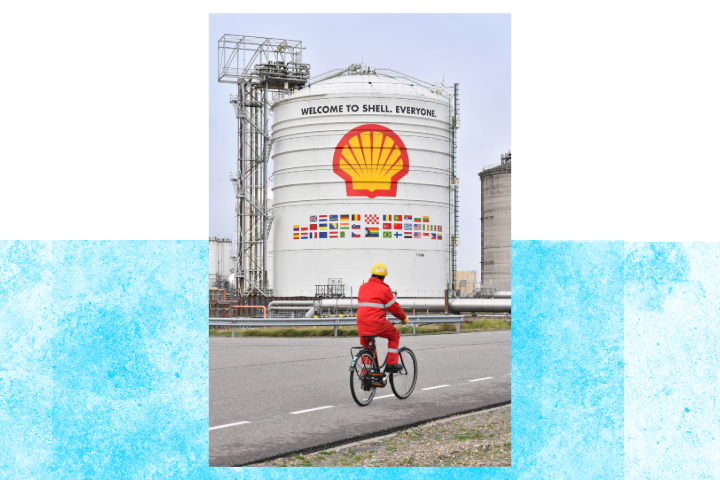
But, van der Sluis, who has over 30 years of experience at the plant, says that even industry-leading process safety frameworks can be improved. ‘From 2016 to 2020, we experienced some emissions that went undetected for a longer period. While they were small, the total release was worth investigating. We simply didn’t see them because it’s not practical to site fixed-point sensors in these areas, and operational rounds in harder-to-reach locations are carried out less frequently due to the size of the site.’
This sparked a rethink: how could the plant cost-effectively extend its detection capabilities across such a vast area without placing permanent sensors on every tower, at every level, or sending operators on potentially dangerous climbs daily?
From Drones to Ground-Based Remote Sensing
The team first experimented with attaching Optical Gas Imaging (OGI) cameras to drones. The results were mixed. ‘When we used a drone to inspect a valve on the roof of one of our tanks, the sensors were capable of detecting chemicals, but the equipment was still difficult to operate and required manual adjustment to identify different chemicals. Another limitation was the drone’s short battery life, which prevented it from providing continuous measurements,’ recalls van der Sluis.
A breakthrough came during a conversation with a gas detection expert at the site, who mentioned Grandperspective GmbH had pioneered ground-based remote sensing technology. The innovation, the scanfeld sensor, combines hyperspectral imaging with Fourier-Transform Infrared (FTIR) remote sensing. A single scanfeld sensor can detect and visualise more than 400 different gases over an area of up to three km2.
Van der Sluis, who was curious to find out more, contacted Grandperspective’s CEO, Peter Maas, to explore whether this new approach could provide greater visibility.
Testing in a Turnaround
They decided to test the technology in the most challenging of scenarios. The ultimate test of any detection system comes during a turnaround, when equipment is shut down, opened, inspected, and repaired before being restarted. These start-up periods carry elevated risk: as temperature and pressure gradually build up, tiny shifts in metal can cause leakages which are sometimes hard to spot.
‘After a turnaround, it is absolutely paramount that any leak is identified at the earliest possible stage,’ explains van der Sluis. Before start-up, the plant already operates a highly structured leak testing programme, but the team was keen to see whether the scanfeld system could add another layer of visibility.
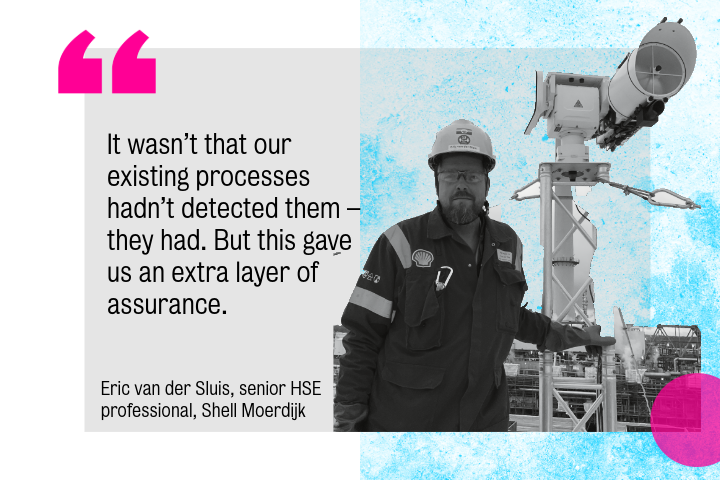
When one of Grandperspective’s cameras was positioned near the tanks during a turnaround, it immediately picked up hydrocarbons. ‘It wasn’t that our existing processes hadn’t detected them – they had,’ he says. ‘But what this gave us was an extra layer of assurance, and the knowledge that we don’t always need to send operators up 80-metre columns. Knowing this system is working continuously and autonomously, 24/7, 365 days a year, gives us a level of safety we never had before.’
The success of the initial trial secured funding for a longer test phase. One scanfeld sensor was installed for an 18-month pilot programme, and following its success, three more were added. Once all four are fully operational, they will cover around 75% of the 320-hectare site.
Transforming Visibility
The results so far have been encouraging. The remote sensing system has already helped detect at least 10 emission events that conventional systems and operators would have taken more time to detect. More importantly, the technology has transformed post-event analysis.
‘With Grandperspective’s sensors, not only are we notified immediately of a leak, but we also know what gas, where and how much,’ says van der Sluis. ‘This has given operators a completely new insight into site emissions and has significantly improved our process safety procedures.’
One example highlights this value. ‘One of our plants uses ammonia. Every two months ammonia is delivered by truck and offloaded in a segregated zone without conventional sensors. After installing the scanfeld cameras, the team was immediately alerted to a tiny boil-off emission from the flexible hose used in unloading,’ says van der Sluis. ‘The emission was well within the limits of our environmental permit, but that isn’t the point. Stopping it at source allowed us to tweak our operating procedures. Without this visibility, we would never have known.’
Building a Safety Legacy Beyond Compliance
For a facility of this scale, compliance with environmental permits is only the starting point. What sets Moerdijk Chemical Park apart is its willingness to go further – leveraging cutting-edge technology not just to meet legal obligations, but to continually raise the bar on safety and sustainability.
To staff and contractors, this effort is more than a regulatory requirement; it is a cultural imperative. Every employee, from senior engineers to new contractors, is trained to see safety as their personal responsibility. Remote sensing technology, in this context, is not a replacement for human vigilance but a complement to it. It extends the eyes and ears of operators across areas once considered inaccessible or too low risk to justify constant monitoring.
Looking Ahead
As the pilot’s success spreads through the organisation, interest is growing in rolling out the technology to other Shell petrochemical plants in Europe and the Americas. ‘There is interest from the HSE community,’ says van der Sluis. ‘Because these systems provide yet another layer of visibility. They don’t replace experienced operators, but they strengthen our process safety, environmental and sustainability frameworks. That on its own is transformative.’
For Moerdijk Chemical Park, the investment in remote sensing technology reinforces its broader mission: to produce the chemicals essential to modern life while maintaining the highest standards of safety and sustainability. And for the thousands of employees and local residents who live and work alongside the facility, it is further proof that safety is not just an operational priority – it is the foundation on which the entire plant is built.