
Dr. Therese Keck, head of professional services at Grandperspective, and content specialist James Gordon review the case for PGS-12 safety standards
Ammonia is fast becoming a fundamental pillar of Europe’s energy transition. What for years was considered a major fertiliser feedstock is increasingly being looked at as an energy carrier, a marine fuel and a hydrogen vector.
The environmental benefits are clear but the scaling-up of the ammonia economy poses challenges for regulators. Leading the way is
the Netherlands, where demand for increased storage and import capacity at the Ports of Rotterdam and Vlissingen has been most keenly felt. This major increase in ammonia storage, with many new entrants showing interest in storing and using ammonia, has put increased pressure on Dutch regulators to significantly revise the national guideline governing the storage and handling of ammonia, PGS-12.
From Niche Guideline to Strategic Framework
The regulatory bodies that grant PGS-12 permits saw a big market change. In the last decades, it was mainly Yara and OCI who were handling large-scale refrigerated ammonia storage. Other players were handling much smaller volumes and ammonia’s chief use was for fertilisers.
In the last few years, however, driven by the energy transition, the market suddenly expanded beyond fertiliser producers to embrace hydrogen carriers. ‘As a result, there were ten initiatives seeking large-scale ammonia storage, with proposals to increase capacity ranging from 20,000 tonnes to 60,000 tonnes,’ says Jochem Langeveld, a senior project leader at the largest environmental protection agency in the Netherlands, DCMR Milieudienst Rijnmond.
That meant revising the PGS-12 guidelines. To properly effect change, a PGS-12 working group, which included regulators and industry representatives, was formed. ‘Ammonia is not a common chemical to handle in very large quantities. Ammonia is among the top 10 most produced chemicals in the world and requires specific expertise to store and use safely,’ says Manuel Dhondt, a process safety lead at Yara’s Sluiskil site in the Netherlands. ‘If companies without experience start storing ammonia, the potential for serious incidents increases. That’s why reviewing PGS-12 was so important.
This led to the NEN Institute, which is tasked with developing and maintaining standards, publishing new guidelines in February 2024, with seven key changes to improve safety and durability. The revised guidelines, which draw on decades of operational experience, accentuate prevention and early detection to avoid incidents. One of the key requirements of the revised PGS-12 guidelines demands that new ammonia tanks in the Netherlands be fully contained with protective blast walls. PGS-12 recognises that existing double-containment tanks cannot be converted to the full-containment concept. However, the guidelines, which are prescribed in terminal operating permits, mandate that the Safety Integrity Level (SIL) of safety systems must be upgraded.
A Move Beyond High-Level Regulation
So, in addressing tank design, containment, inspection regimes and detection requirements, is this what makes PGS-12 stand out compared to other ammonia frameworks such as the SEVESO Directive?
Aliaksei Patonia, a research fellow at the Oxford Institute for Energy Studies (OIES), thinks so. He believes that the growth of green ammonia – particularly for shipping, but also for industrial uses – is likely to lead to more decentralised production, storage and handling, often closer to ports and population centres. ‘In that context,’ he says, ‘the Dutch approach is interesting because PGS-12 goes beyond high-level EU frameworks such as SEVESO by offering detailed, technically prescriptive guidance tailored specifically to ammonia.’
The problem Patonia highlights is that, while existing ammonia regulations are generally legally sufficient, questions arise as to whether they provide insufficient operational guidance. ‘PGS-12 adds value by embedding accumulated operational experience into a consistent set of expectations. Therefore, it improves safety not by increasing regulatory burden but by increasing clarity, predictability and comparability across projects,’ he says.
The value of embedding operational experience rapidly becomes clearer when we look at how the new PGS-12 guidelines have evolved with the input of industry leaders like Yara.
Continuous Monitoring – A Fundamental Sea Change
Perhaps one of the most significant changes to the updated PGS-12 guidelines is the importance they place in monitoring and detection. The guidelines mandate the use of continuous detection systems that must cover all potential leak sources and be incorporated into process safety frameworks.
Previously, ammonia storage facilities relied primarily on local fixed-point sensors positioned around pumps, compressors and transfer points, while operators also relied on their sense of smell, remaining alert to potential leaks during inspection rounds.
Dhondt, who has spent three decades working in the process industry, outlines the wider issues. ‘Local detectors are sensitive to wind direction and wind speed, require extensive maintenance, and only tell you what is happening at a specific point. On a site of our size, it’s simply not feasible to install sensors at
every point source.’
With PGS-12 recognising the role of continuous, wide-area monitoring as part of a multi-layered approach, many sites are strengthening their process safety frameworks. Alongside periodic inspections and increased operator presence, they are moving towards a 24/7, 365-day-a-year visibility approach, enabling the detection of tiny ammonia releases before they escalate.
According to Patonia, this is an area where technology could significantly shape future safety standards. ‘Advances in continuous ammonia leak detection, sensor redundancy, digital monitoring and integration with control systems allow for earlier intervention and more granular risk management,’ he explains. ‘Over time, this may enable a shift from purely prescriptive design rules toward performance-based standards that explicitly recognise real-time monitoring and automated safety responses.’
PGS-12 Highlights the Limitations of Legacy Systems
Beyond their ability to monitor specific hotspots, ground-based remote-sensing systems address a key limitation in traditional ammonia detection practices. ‘In the past, some leaks were discovered during routine operator rounds,’ explains Dhondt. ‘If a release occurred shortly after an inspection, a small escape could theoretically go unnoticed for hours. That would not only increase risk but also complicate response efforts. Continuous monitoring systems allow immediate action because the area is scanned all of the time.
This closely reflects PGS-12’s emphasis on prevention and rapid intervention. ‘Ammonia is toxic,’ concludes Dhondt. ‘We already operate to strong internal standards based on Fertilisers Europe guidance and Yara’s own technical documents, which were even stricter than the previous PGS-12 guidance. We know that we operate safely and that the likelihood of an incident is low. However, in the event of a major release, even fire brigades have limited tools beyond dilution and dispersion. That’s why early detection is so important.’
PGS-12: A Guideline for Europe?
The Yara Sluiskil case study (below) demonstrates how PGS-12 moves beyond compliance by translating paper-based regulation into practical safety outcomes in complex, high-risk environments close to population centres.
As Patonia notes, the value of PGS-12 lies not in being copied word-for-word,but in providing operators – including new market entrants – with a robust framework that shows how operational experience can be translated into ‘engineering-relevant requirements rather than remaining purely principle-based’. This raises an important question: could PGS-12 provide a template for ammonia storage safety elsewhere in Europe? Patonia believes it is quite plausible ‘that elements of PGS-12 could be adapted or referenced’ by other European countries, particularly those positioning themselves as ammonia hubs.
DCMR’s Langeveld agrees, noting that PGS-12 is already becoming a reference point. In Belgium and Denmark, permits increasingly adopt its principles, while he says in Germany ‘the PGS-12 guideline is also part of our discussions with the city of Hamburg’s Environment, Climate, Energy and Agricultural Authority (BUKEA)’.
However, he cautions that adoption may vary globally. ‘PGS-12 lends itself well to European import terminals located close to built-up areas. Japanese regulators may take a different approach due to earthquake risk, while US lawmakers may simply decide to make
different choices.’
Only time will tell whether PGS-12 becomes a global blueprint, but with its growing influence beyond the Netherlands – particularly around continuous visibility, early warning and demonstrable safety performance – its impact is already being felt.

How Yara Sluiskil Benefits from Early Detection
A practical illustration of this approach can be seen at Yara Sluiskil. Situated on the banks of the Ghent-Terneuzen Canal in the south west of the Netherlands, the facility contains a dozen production units, including three ammonia plants, as well as nitric acid, ammonium nitrate, urea and loading facilities, making it Europe’s largest ammonia and fertiliser production site. The facility accounts for more than 10% of European ammonia production capacity and approximately 1% of global production capacity.
Process safety at the 1 km² site is handled by a specialised team embedded within a wider HSE function of approximately 50 staff working in close cooperation with engineers from the relevant production departments. ‘Prevention is always the priority, and early detection is critical,’ says Dhondt, explaining how the site approaches ammonia risk management. ‘With Grandperspective’s cameras, we have a continuous overview of potential emissions, allowing us to detect leaks much earlier. That early warning gives us time to respond appropriately – whether that means carrying out a minor repair,
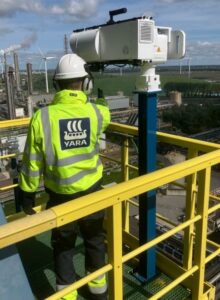
isolating part of the system by closing valves, or, in the worst case, taking an installation completely out of service. The faster you detect a small release, the more options you have to intervene.’To support this, Yara uses ground-based remote-sensing technology supplied by Grandperspective GmbH, which delivers monitoring solutions to chemical = companies, petrochemical producers and international oil companies. Yara operates a hybrid sensor network, using local detectors in indoor areas, while Grandperspective’s sensors provide continuous, wide-area visual monitoring of high-risk zones, particularly atmospheric ammonia storage tanks and associated equipment. Yara began deploying two of Grandperspective’s Scanfeld sensors in 2024 as part of a development and testing phase, following introductions at industry conferences where the system was presented and further discussions with industrial peers, including OCI and Shell – both of which had direct experience with the technology.
Discover continuous monitoring solutions to help you comply with PGS-12 and similar safety standards through Grandperspective.