

Fresh from the inaugural NATO Pipeline System Conference, FETSA’s executive director, Ravi Bhatiani, reflects on the need to balance civilian and military fuel requirements in a rapidly transitioning sector
According to the Nato Pipeline System Conference (NPSC) website, the NPSC serves as a strategic platform for allied collaboration to safeguard and optimise this vital infrastructure. The inaugural conference brought together subject-matter experts, decision makers, and operational leaders, including FETSA, who represents 700 terminals across Europe. While the event was an excellent opportunity to network with other organisations working to better understand this critical infrastructure, the conference sessions also addressed priorities such as enhancing resilience, interoperability, and operational aspects.
According to the NATO website, the pipeline system was created in response to the logistical challenges of maintaining a robust energy supply during the Cold War. The NATO Pipeline System was designed to enhance the alliance’s operational readiness and sustain its collective defence capabilities. Its primary role is to transport and store fuels such as jet fuel and diesel across a vast network of interconnected pipelines, pumping stations, and storage facilities spanning multiple countries.
This integrated system remains a cornerstone of NATO’s collective defence strategy, ensuring that fuel requirements are met efficiently under any operational scenario.
FETSA terminals are generally viewed as critical infrastructure – not just for the energy provisions of a nation, but from a strategic and defence perspective. FETSA works closely with the UN, EU, NATO, IEA and other bodies on issues such as security of supply, military mobility, transition fuels, stockpiling and safety. FETSA has a working relationship with the European Commission and stockpiling entities when it comes to developing the EU’s energy security framework for liquid products.
Demand For Storage
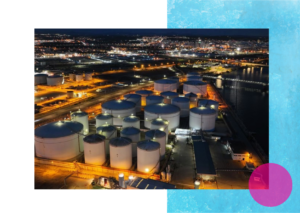
Liquid bulk storage represented by FETSA is approximately 136 million m³. Storage in the NPS, according to NATO’s own website, is 4.1 million m³ – this shows the importance of commercial infrastructure in a crisis response. As the consumer market moves towards lower-carbon options, a high-intensity conflict scenario could also require private storage terminals to be part of the European defence logistics.
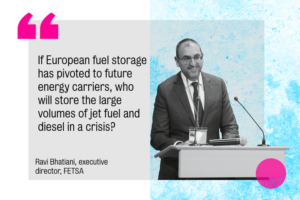
For example, consumption of jet fuel and diesel by the military in a European high-intensity conflict scenario, according to FETSA’s research and based on public data, is likely to require a high level of private sector participation in meeting storage requirements. But if European fuel storage has pivoted to future energy carriers, who will store the large volumes of jet fuel and diesel in a crisis? And how would this impact the European defence logistics agenda?
At the time of current geopolitical volatility, both military and commercial planning must take into account the likelihood of worst-case scenarios. In all cases, this means that there would be a continued and intensive need for storage capacity of fossil products in the future – the timeline for phase-out of fossil fuels in the military does not match EU climate goals of net-zero by 2050.
This creates the key dilemma. There is a civil/military divergence. The civilian side shows a demand signal and investment needs in energy transition compliant products, lower carbon, renewable sources, etc. Meanwhile, the military needs remain fossil-based.
Phasing Out Fossil Fuels
However, the military does not drive storage investment decisions today. They are made according to commercial realities, which are based on energy transition demand signals.
According to FETSA’s research and estimation, significant volumes of fossil fuel storage will leave the market by 2030, 2040 and 2050 as we progress through the energy transition. At the same time, 2030 is seen in public EU policy documents, it is called Readiness 2030, as the timeline for worst-case scenarios crystallising. So, while the commercial arms of storage terminals are working towards a cleaner, greener future, it’s possible that governments will expect that fossil fuel storage is readily available in a crisis.
But if these storages have been phased out, as is forecast today, that infrastructure will be lost. It will not be rebuilt. Consumers and customers will have pivoted to new fuels and feedstocks – and governments will be missing critical assets that have been phased down.
So, how can we solve this? Global collaboration has been a cornerstone of both NATO and the wider commercial market for decades. Diplomacy and engagement are complementary to preparedness and deterrence.
In the same vein, cross-sector collaboration will be critical to ensure Europe’s military logistics needs are taken into account as we pursue the energy transition.
Is Policy The Solution?
The European Commission has already implemented the Oil Stocks Directive, ensuring that any EU member state must maintain a minimum stocks of crude oil and/or petroleum products. This generally is for the supply chain security for civilian consumption e.g. in transport or industrial processes, but could a higher stocks target bolster security for the military too? If the aim of strategic stockholding is for those products to be used in an urgent case or local crisis (i.e. disruptions in the supply of natural gas which require fuel switching), then a worst-case military scenario would also be relevant for scenario planning.
The review of the EU energy security framework is also important to prepare for worst case scenarios. There are no EU mandated stocks for gas/LNG, nor for alternative energy carriers such as SAF, biofuels feedstocks, hydrogen or liquids that can be used to store hydrogen more easily (e.g. liquid organic hydrogen carriers, ammonia, and methanol). Although the Oil Stocks Directive covers, to some extent, the storage of biofuels, there are also no EU mandated stocks for low carbon and renewable liquid fuels, which could easily offer a substitute for refined products (e.g. synthetic fuels, e-fuels etc).
There is still good news, however. The European Parliament has discussed a review into the directive, and overall energy security of supply. FETSA and UPEI released a joint statement on this topic in July 2025, welcoming the comprehensive and forward-looking approach to strengthening Europe’s energy security framework.
For one, the draft resolution specifically called for a review of the Oil Stocks Directive to better reflect evolving risk profiles and energy needs – a hugely positive step. The resolution also acknowledges the strategic role of NATO in Europe’s future energy security architecture. Moreover, it emphasises the importance of dual use infrastructure, promoting greater synergy between civilian and military preparedness. Strengthening these shared systems improves overall resilience because the same robust infrastructure helps keep society running smoothly and supports security and defence needs.
Joined-up Thinking
A deeper collaboration between the military and civilian sector must take place. Whether this is through bringing together all players in energy logistics and ultimately coordinating exchanges between civilian and military players and defence authorities, or through cross border cooperation to ensure the stability, efficiency and security of supply.
As energy systems become more connected across borders, acting alone often creates inefficiencies, market distortions, and new supply risks. Cooperation should not be limited to network infrastructure and emergency response tools, even though these remain essential for preventing congestion, improving flexibility, and making better use of resources across regions.
National choices to remove generation capacity – such as closing nuclear power plants – can strongly affect the availability and affordability of energy in neighbouring countries. In some cases, these impacts are significant enough that countries consider shielding their markets from wider EU energy influences. Energy security is increasingly a shared responsibility among EU member states, and decisions of this scale call for much closer coordination. Bridging the gap between civilian infrastructure and commercial demands, versus that of the military in a worst-case scenario will be essential to ensure that Europe’s evolving energy system remains both resilient and secure.