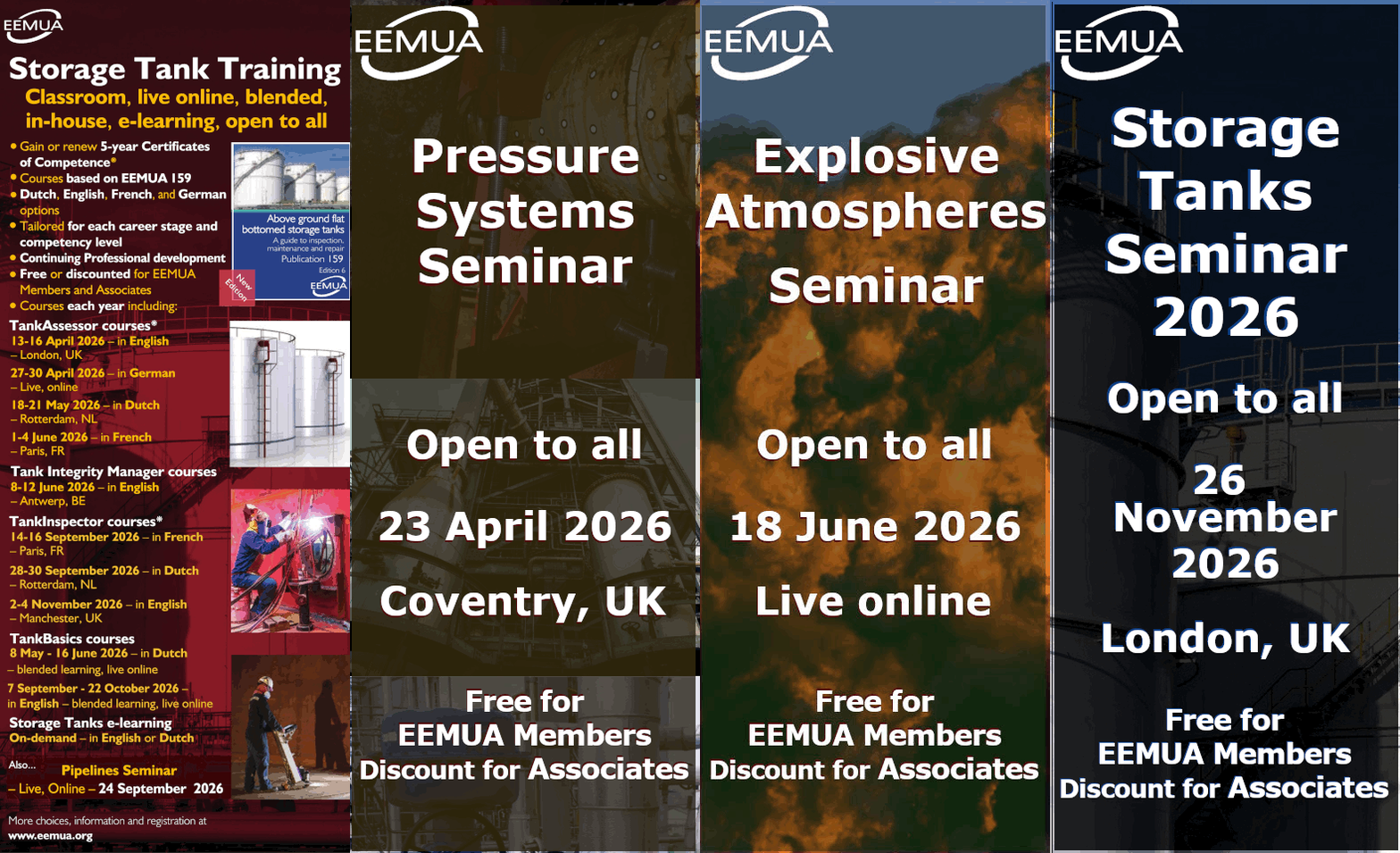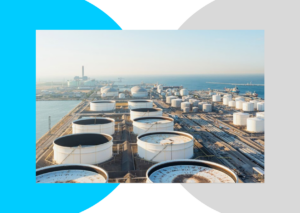


Terminal manager at LBC Rotterdam, Mathias Potvin, explores the role of tank storage infrastructure in enabling a net-zero economy
The circular economy is rapidly moving from theory into operational reality, and tank terminals have a growing role to play in making that transition scalable. Terminals are no longer only logistics nodes that store products until they are shipped onward. Increasingly, they are becoming infrastructure enablers of circular supply chains, supporting new product flows, evolving customer expectations, and the wider shift toward net-zero industrial systems.
In this changing landscape, circular thinking starts with a simple but important point. Terminals should aspire to become net zero themselves. Terminals are part of their customers’ Scope 3 emissions, so every improvement made in a terminal’s own operations directly benefits its partners and the wider value chain.
LBC Tank Terminals in Rotterdam (LBC Rotterdam), is working very intensively on this transition. LBC’s approach can be divided into two main pillars: optimising current operations and investing in the fuels of the future. On the optimisation side, the focus is on improved insulation, replacing high-energy consumers with more efficient units, and overall energy efficiency improvements. These actions have already enabled LBC to achieve a massive reduction in CO2 emissions at the Rotterdam terminal. The second pillar is forward-looking investment. Over the past few years, significant investments have been made to future-proof LBC Rotterdam’s infrastructure. Today, the terminal can confidently state that all units currently operating on natural gas are compatible with hydrogen combustion.
There are, however, external challenges beyond the terminal fence line. Looking specifically at Rotterdam, two major bottlenecks stand out. The f irst is electricity, where grid congestion has become a serious constraint for companies that want to move forward. The second is hydrogen. The network is not yet fully plug-and-play and additional investments are required to make it operational. This raises an important question: should these investments be taken on by the frontrunners alone, or is there a role for broader support to accelerate the transition?
Circular Supply Chains In Action
Alongside operational decarbonisation, terminals also have a growing role in supporting new circular material flows. At LBC Rotterdam, this is reflected in a deliberate product focus, where it has consciously anchored itself in supply chains that actively contribute to a more sustainable and circular economy. Many of the products stored at the terminal ultimately serve applications that support sustainability, such as materials used for insulation in buildings, directly contributing to energy efficiency and emission reduction downstream.
One of the clearest examples of circular thinking in practice is LBC Rotterdam’s work in enabling circular plastics value chains. Nearly three years ago, one of its partners approached the terminal with a question that was new territory at the time: whether it could store pyrolysis oil. While unfamiliar, pyrolysis oil offered a critical missing link in plastic recycling, complementing mechanical recycling with a chemical recycling pathway. Importantly, mechanical and chemical recycling should not be seen as competitors. They pursue the same objective, reducing the amount of plastic waste sent to landfills.
What followed was described as a true learning journey, with stakeholders across the value chain working closely together to turn unknowns into operational reality. This required adapting facilities, procedures, and expertise to handle the new product safely and reliably. Today, after three years of development and collaboration, LBC Rotterdam says it can confidently position itself as a regional pyrolysis hub, with the know-how and infrastructure required to support circular plastic flows. Storing circular or waste-based feedstocks involves evolving operational requirements, as these materials are part of relatively new supply and logistics chains.
At LBC Rotterdam, the approach has again been described as a shared learning journey with partners. From the outset, risks were identified and mitigation measures developed, supported by expertise across the value chain. Critical parameters were defined early and are closely monitored in daily operations.
Customers And ESG Expectations Raising The Bar
For terminal operators, circular progress is not only driven by internal ambition. Customers are playing an increasingly decisive role in shaping strategy. Sustainability has evolved from a ‘nice to have’ into a key criterion when forming long-term partnerships. This is reflected in customer expectations, where tools such as EcoVadis assessments are becoming standard, and from an investor perspective, where frameworks like GRESB strongly influence how assets and operators are evaluated. A strong sustainability reputation is now a competitive advantage.
LBC has been investing for several years in sustainability, transparency, and traceability, focusing on long-term responsibility and future readiness. In 2025, LBC Tank Terminals was awarded the EcoVadis Platinum medal for the third consecutive year, placing it once again in the top 1% of more than 130,000 companies assessed globally across environmental, social, and ethical performance. In parallel, it achieved a GRESB 5-star rating and sector leader title, confirming the robustness of its ESG approach. LBC now clearly sees this recognition feeding back into the market, with more customers explicitly valuing strong EcoVadis scores and looking for partners who can support their own sustainability ambitions.
Designing Circularity into Expansion and Logistics
Circular logistics can only work if collaboration across the entire value chain is built into both design and daily operations. At LBC Rotterdam, this mindset is embedded in how the terminal develops, operates, and expands. In the third phase of its expansion project, launched at the end of 2024 and delivered in stages between November 2025 and April 2026, circularity and sustainability principles were integrated from the outset. Sustainability criteria were included in the selection of construction partners. During construction, excavated soil was reused through targeted sampling rather than defaulting to new material, new asphalt concepts were applied, and electrically powered equipment was maximised.
During cleaning and commissioning, water is continuously reused for hydrotesting and pressure testing, resulting in an average reduction of approximately 75% in water consumption.
From an operational perspective, terminals are defined by multiple inbound and outbound flows. LBC Rotterdam describes road transport as the most visible flow, with growing demand for electrically powered trucks and initial discussions already underway. For vessels and barges, the focus is on optimising berth occupancy times, as shorter jetty stays reduce fuel consumption for onboard power generation. Once grid congestion is addressed, implementing shore power would be a logical next step. In the meantime, the terminal logs and analyses nearly every step of its operational process, especially pre- and post-loading activities, to identify efficiencies. It has also initiated exploratory discussions on using drones for sample transport between ship and laboratory, an approach already being piloted in the Port of Antwerp.
Rail is another key lever for circular logistics, described as inherently more sustainable and increasingly in demand due to both climate considerations and growing congestion on highways. LBC Rotterdam’s expansion includes a new block train facility designed to increase rail tank car handling capacity, enabling a full block train of 24 wagons to be loaded or unloaded within 12 hours.
Future Thinking
Looking forward, LBC Rotterdam believes the sector is at the early stages of a new industrial revolution. Progress will not follow a straight line, but one trend is unmistakable: circularity, ecology, and sustainability will continue to gain importance and shape industrial decision making. Circular supply chains will grow, driven by the rising challenge of waste management and the fact that the primary feedstock underpinning many of today’s products is finite. Terminals have a clear role to play in enabling that transition.
At LBC Rotterdam, preparation is already happening through action. The terminal has set a clear ambition to reach net zero for Scope 1 and 2 emissions, supported by investments such as hydrogen-compatible units to decarbonise operations. From an infrastructure perspective, the terminal has been redeveloped as a newly built facility on the footprint of a former production site, designed with flexibility and future adaptability at its core. Phase three of the expansion will be completed and operational this quarter, and the next development phase is already being planned. This approach ensures that as circularity reshapes the tank storage industry, LBC is not reacting to change but actively driving it.