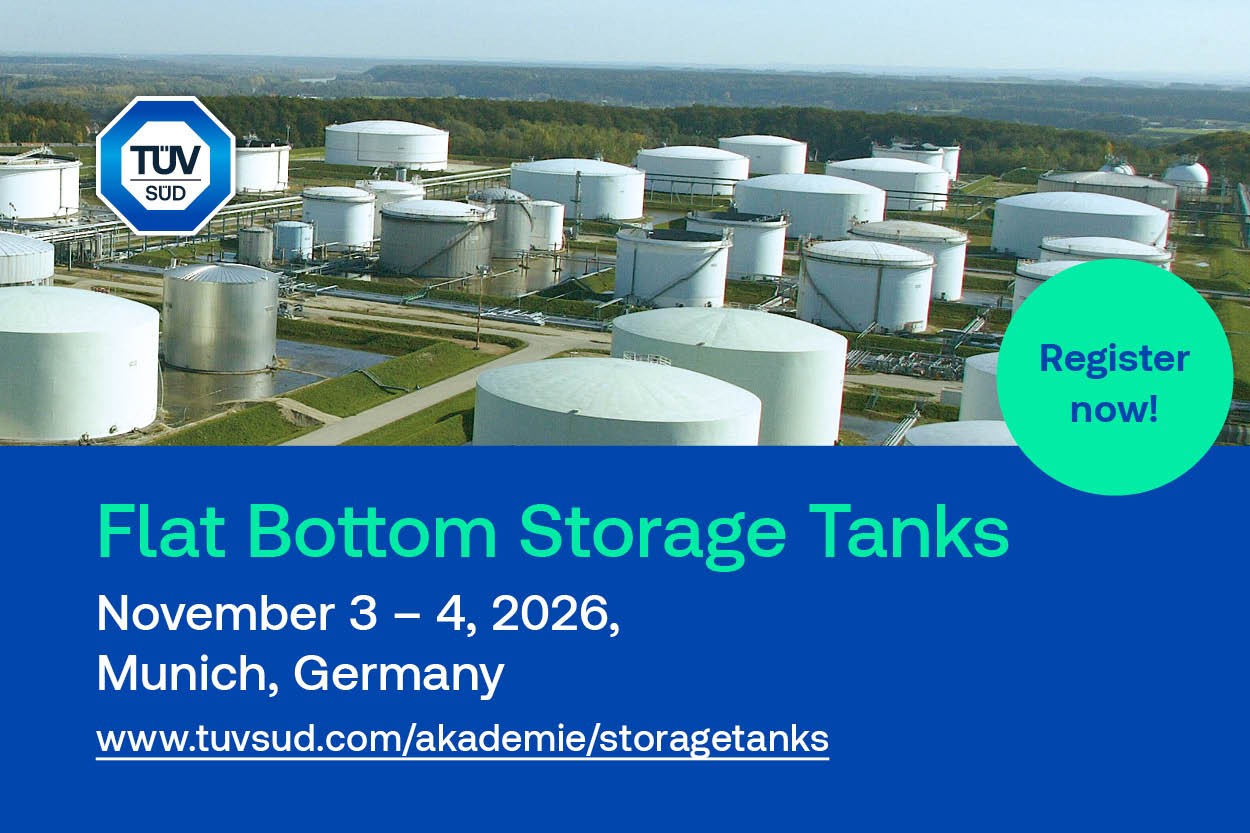



Atlas Geotechnical’s Doug Schwarm provides a case study on tank settlement from Port Moody in Canada
Annex B.1.2 of API 653 Tank Inspection, Alteration and Repair sets the stage for this case history by stating ‘[re]-levelling of a sizable tank is expensive and rather difficult to achieve. Thus, a decision to re-level a tank is a crucial one and relies very much on the proper interpretation and evaluation of the monitored settlement data.’ Tank 42
at Pacific Coast Terminals’ facility in Port Moody, British Columbia, Canada, provides an unsurpassed example of the settlement tolerance of above-ground welded steel storage tanks and how proper interpretation and evaluation
can avoid unnecessary costs and downtime.
The tank measures 120 ft in diameter and 60 ft high (37 m x 18 m) and is on a conventional crushed rock ringwall with a cone-up bottom. The tank is designed for canola oil service (Gs=0.92), so the maximum bottom plate pressure is
3,400 lb/ft2.
HYDROTEST SETTLEMENT
Figure 2 shows the elevation surveying results for two points around the Tank 42 periphery during the pre-service hydrotest. The red line indicates the water level, which was held at 13.5 m for about six days before being increased to the 18.0 m design depth for an additional 10 days.
Total uniform settlement of 44 mm (about 2 in) was not unexpected for the waterfront site. However, settlement of up to 12.5 in at one point was much more than the design team had expected. The maximum tilt between points 4 and 10 was 11 in, enough to cause significant concern about the tank’s integrity.
The design engineer undertook a rigorous engineering analysis of the settled tank that employed numerical simulation using four different software packages. Rather than offering improved understanding of Tank 42’s fitness for service, the models yielded improbably diverse results ranging from moderate yield to almost certain tank failure. Obviously, the tank had not failed, and the shell appeared only slightly deflected. The difference between the model results and observable conditions prompted Pacific Coast Terminals to retain an expert tank engineering consultancy for an independent analysis.
Interestingly, the settlement data during the 44-day hydrotest interval were presented in tabular form, not graphically as shown in Figure 2. The first step of the analysis was to present the data using tools very familiar to tank inspectors and engineers. The hydrotest monitored settlement at 12 locations around the periphery and points 4 and 10 are diametrically across from each other, an observation that would be crucial to the detailed analysis.
API 653 FOUNDATION
SETTLEMENT TOLERANCE
A brief overview of tank foundation settlement may be appropriate before describing the analysis and mitigation that allowed the tank to be placed in service.
Foundation settlement can be interpreted as the sum of total, planar, and non-planar differential:
- Total settlement is the amount of settlement that can be applied equally at all points.
- Rigid planar tilt of a circular tank base, when unrolled onto the abscissa of the graph, is represented as an optimum cosine curve.
- Non-planar differential is the excursion above and below the optimum cosine curve.
That third component, differential settlement away from a tilted plane, is the important one. Differential settlement induces shear that deforms the shell away from cylindrical, potentially causing floating roof problems and, if severe enough, overstressing the welds and steel.
Importantly, API 653 places no limits on uniform or planar-tilt settlement. Assuming that piping connections are relieved and that the deeper liquid level on the downside remains within design limits, stresses in the tank shell are nominally unchanged for almost any credible amount of uniform and rigid planar tilt settlement.
SETTLEMENT MITIGATION
Plotting out the hydrotest elevation data yielded a clear indication of planar tilt with almost no differential above or below the optimal cosine curve. Figure 3 shows the results of the internal bottom scan, which confirms that the tank tilted about 16 in from 90° (point 10) to 270° (point 4). It also revealed that the initial 15 in (374 mm) cone-up centre had settled to about 6 in.
Even though the review was being performed using API 579 Fitness-for-Service methodology, these data allowed an early conclusion that the tank remained within API 653 limits for foundation settlement. The review team concluded that almost certainly the tank could be placed in service with manageable repairs.
Point 4, the lowest around the periphery, had been settling at a rate of about
5 mm/day when the hydrotest ended and the load was removed. Extrapolating the data suggested that several more inches of planar tilt would occur after filling the tank with canola oil. It was decided to pre-induce this settlement by re-filling the tank with water for an additional few weeks. After the remaining settlement had reduced to within tolerable limits, the tank was drained and re-scanned to confirm that the extra several inches of settlement continued to be almost perfectly planar.
Before placing the tank in service, the internal columns were adjusted to match the settled distance between roof and floor and the piping connections were adjusted to match the settled nozzle elevations. By good fortune, the large-diameter nozzles happened to be on the ‘minimal settlement’ side of the tank. The columns and the piping were both set a little high or a little long anticipating modest long-term additional settlement.
5-YEAR PERFORMANCE
Tank 42’s first 5-year in-service inspection was completed in January 2019. Figure 4 shows the history of settlement for each foundation monitoring point around the tank chime. Pairs of points are assigned matching colours as a way to emphasise how truly planar the tilt has remained.
Over its first five years of service, Tank 42 has settled up to 19 in, with differential of 17 in across the diameter. Differential settlement away from the optimal cosine curve continues to be inconsequential. Figure 4 shows the January 2019 foundation settlement curve. In over 30 years evaluating tank foundation settlement problems, the author has never encountered a similar occurrence of almost perfect planar tilt.
External scans indicate that the shell is up to 8.54 in out of plumb over its 60 ft height, a tilt of 1.2%. The tilt is noticeable to observers standing in the optimal location. For comparison, at its maximum, the leaning tower of Pisa tilted 3.9 m over its 55.9-m height, a slope of 6.98%, almost 6 times more tilted than the Tank 42 shell.
SUMMARY
The planar tilt that affects Tank 42 demonstrates the resiliency of above-ground welded steel storage tanks. Foundation settlement is often unavoidable, but tilt of this magnitude could not have been anticipated. Pacific Coast Terminals exhibited exemplary management when they authorised a detailed engineering assessment and, when that assessment returned results inconsistent with observed conditions, retained an expert for a careful interpretation and evaluation of the monitored settlement data.
The guidance in API 653 Annex B represents over 50 years of collected industry wisdom about operating safely in the face of difficult foundation conditions. Familiarity with, and effective use of, the standards helped avoid an unnecessary re-levelling and allowed the tank to be placed into service with minimal delay.
Acknowledgements
This paper grew out of a presentation at ThinkTanks21, an industry event sponsored by Ranger Inspection and PEMY Consulting. The author is grateful to Phil Myers and Alex Romanow for inviting us to present. Bill Thiessen and Andre Olivier at Pacific Coast Terminals deserve our appreciation for recognising the value of sharing this case history with other operators and engineers.
For more information:
Doug Schwarm, PE, GE, PEng, is Chief Engineer at Atlas Geotechnical, a foundation engineering consultancy serving heavy infrastructure clients throughout North America and the Pacific. In 30 years supporting the oil and gas industry he has sorted out tank foundation problems from Fort Mac to Pascagoula, Newfoundland to Guam.