


Dependable factory calibration saves time during commissioning and provides better accuracy assurance than field calibration, says Daniel Hoy, Endress+Hauser
Since the dawn of human history, trade has been an essential part of the social construct, and every fair exchange depends on mutually agreed and fulfilled measures of goods. In trade industries, especially in the custody transfer of petroleum goods, weights and measures play a fundamental role for accurate transactions of money and products. Instruments quantify conditions in all controlled applications, and measurement accuracy directly impacts revenue streams, product quality, and operational safety.
While the first modern legislative enforcements for weights and measures were institutionalised by local
government decrees, they are now upheld by well-known metrological standards, based on international studies and proven principles.
Weights And Measures In Custody Transfer
All instruments, even the most accurate, exhibit a certain degree of measurement error, which is the difference between the measured value and the reference value.
The tank gauging market places strict requirements on the accuracy for custody transfer level measurement. Standards such as OIML R85, API 3.1B, and ISO4266, each define the required field accuracy in addition to required calibration specifications. For example, OIML R85 requires field verification within +/- 4 mm to manual dipping, with an approved tape on top of the tank in which the gauge is installed. However, the same instrument must have an accuracy of +/- 1 mm against a reference in a controlled environment, such as a factory test rig. The use of a verified and calibrated laser measurement device with a one micrometre resolution is typically used for this initial verification.
Following OIML recommendations, the initial verification of measuring devices must be performed under reference conditions, and at least 10 measuring points must be recorded, evenly distributed over the measuring range.
Calibration Overview
In short, calibration is a process of establishing a relationship between a quantitative measurement and a known reference with the goal of determining measurement errors of a given device, referred to as the unit under test (UUT). Once the measurement errors are known, a UUT can be used as a reference to calibrate other instruments, and master meter proving is a common example of this practice. This calibration chain must always be traced back to national or international primary references to ensure metrological traceability.
In most industrial facilities, instrument calibration is required prior to operation. This means it must be carried out either in the factory before delivery, or in the field after installation. Reliable calibration is critical for long-term process reliability, equipment condition, minimising maintenance requirements, and the highest product quality or metering accuracy – so it is important to choose the best method for initial calibration.
Factory calibration can save end users a lot of time that would be spent on complex and cumbersome field calibration procedures – which can sometimes take up to several days in large tank gauging applications – and it also provides carefully documented calibration records. Additionally, factory calibration is much more accurate than field calibration because the environment is carefully controlled to minimise interference from external factors. Greater accuracy leads to improved automation system performance due to better data on which to base operational decisions throughout a product’s lifecycle.
For these and other reasons, users typically prefer factory over manual field calibration. With continuous level sensors for tank farm and custody transfer metering applications, historic limitations have restrained factory calibration capabilities. However, modern technological innovations are expanding the calibration boundaries for both the radar and servo level instrumentation typically deployed in these settings.
Microscopic adherence to the reference standard and tight regulation of environmental conditions are two of the most critical components in ensuring accuracy and consistency of leading factory calibration settings from one test to the next. Variables such as ambient temperature, humidity, pressure, vibration, and electromagnetic interference all impact instrument measurements, so these and other factors must be carefully controlled.
Radar Level Calibration
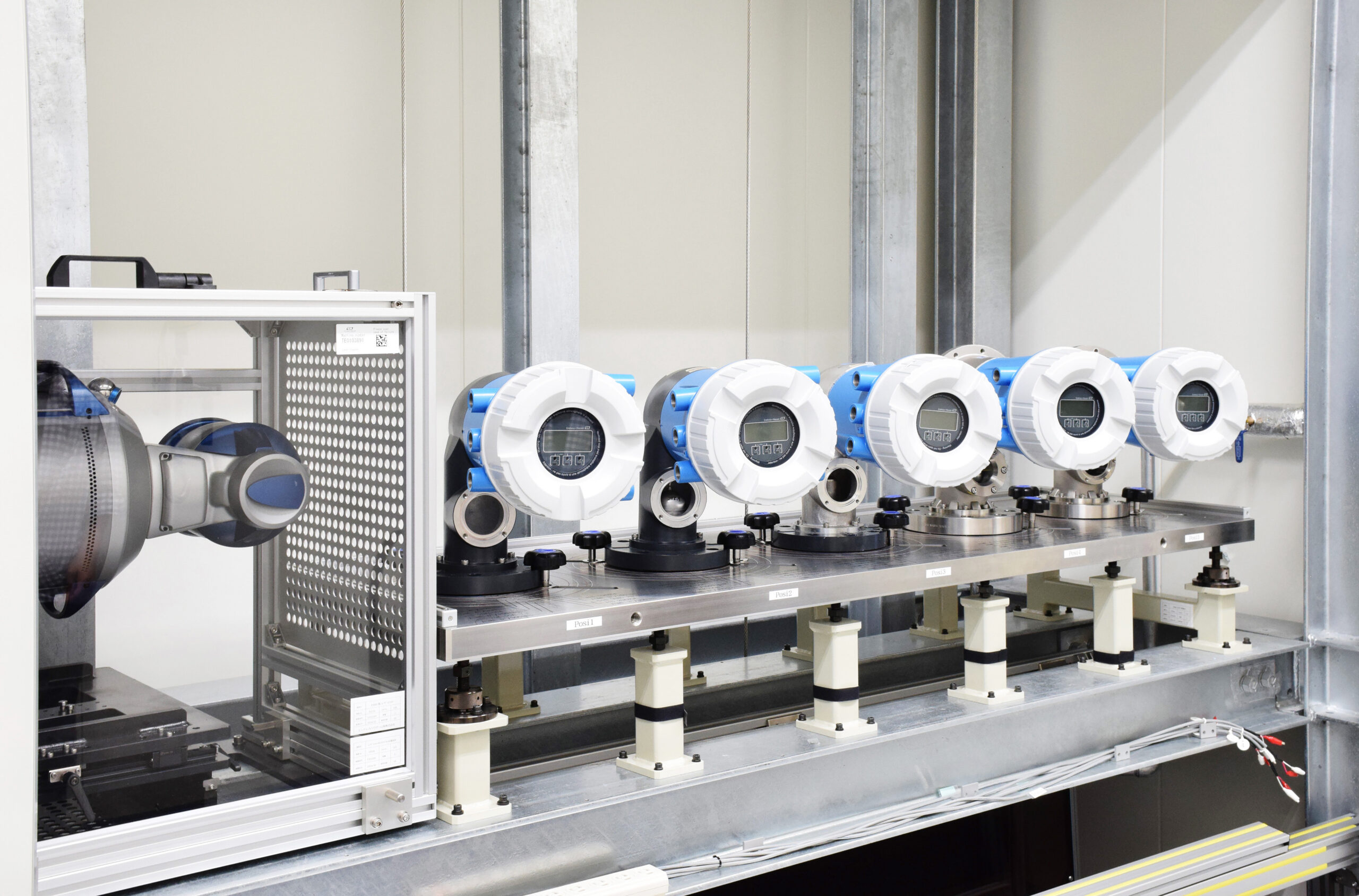
Endress+Hauser’s radar level calibration rig at its production facility in Maulburg, Germany, for instance, is located in a basement with floor and ceiling controls to ensure constant ambient conditions. The floor is also suspended to reduce residual vibrations. Controlling these and other variables reduces system uncertainties during calibration.
Non-contact radar technology offers a flexible level measurement solution for many applications – especially tank gauging – even in the presence of extreme pressures, temperatures, or gaseous vapours. Radar level sensors emit high-frequency radar pulses that are reflected by the surface of the medium due to the difference in the relative dielectric to air. The reflected radar pulse’s time-of-flight is directly
proportional to the distance traveled, and in turn is used to calculate the level based on known tank geometries.
Modern large-scale radar calibration rigs essentially consist of a high-resolution laser, a two-sided reflector, and the level UUT as well as components for controlling the ambient environment. The Endress+Hauser Level+Pressure facility in Maulburg, Germany, has four calibration rigs, each of which is suitable for different radar level technologies and application requirements.
After the UUT has been carefully placed at a defined distance D from the laser, the reflector is iteratively moved to various positions between the laser and radar level instrument. The measurement error (E) at each point during the test is recorded as E = D - A - k - B, where A is the distance from the laser to the reflector, k is the width of the reflector, and B is the measured distance between the reflector and the UUT.
Then, the error values are all documented in a factory calibration report – depending on application, industry, and end user requirements – and the instrument is accepted for service and shipped to the purchaser.
Servo Level Calibration
Servo sensors are the other most commonly deployed level instrument in tank farms for the precise measurement of petrochemical volumes in custody transfer and inventory control applications. A servo level gauge consists of a small, buoyant displacer that is held on the surface of a liquid medium by a servomotor. The displacer is suspended on a measuring wire that is wound onto a finely grooved drum housing, and as the medium surface level fluctuates and the displacer bobs up or down, the torque
in the motor’s magnetic coupling varies. The servo motor then adjusts its position until the net torque is restored to the value prior to the level change. This position adjustment corresponds to a change in the liquid level.
In 2014, Endress+Hauser unveiled the world’s first 40-metre-high calibration tower (for servo level gauges at its production facility in Yamanashi, Japan). The tower rises 10 m above the surface and sigs down 30 m below grade, providing stringent control over ambient conditions that – left unchecked – can interfere with calibration.
A servo calibration tower contains a liquid bath whose level changes during calibration. Like a radar calibration rig, it also uses a high-resolution laser, which is aimed at a reflector on the surface of
the liquid. This measured distance is then compared to the level measurement of the servo UUT. The measurement error is recorded as E = C + B - A - D, where C is the distance between the laser and reflector, B is the reflector width above the surface of the medium, A is the vertical distance between the laser and servo’s zero-point, and D is the level measurement of the UUT.
Only recently have construction, testing, and climate control technologies enabled the precise conditions required for this type of high-accuracy premium calibration rig, which is considered the de facto test for assessing device accuracy. The ISO/ IEC 17025 certificate empowers operators of these rigs to provide precise accredited and traceable calibrations for servo gauges used in tank farms and other level- sensing applications around the world, eliminating the need for cumbersome and less accurate field calibration before the instruments are put into operation.
Modern Calibration Rigs Increase Process Reliability
Reliable instruments that can be traced back to accurate and trustworthy references are the measures of all things in modern industry. In highly competitive markets, measurement reliability and controlled processes are vital as they provide companies with the tools to remain viable.
High-precision calibration rigs enable processors to use reliable instrumentation from the factory,
eliminating the need for field calibration during commissioning, and providing higher level of confidence throughout the operational lifecycles. Paired with other advances, such as analytical reporting software and smart device diagnostics, plant personnel waste less time worrying about measurement errors and lost revenue and instead use it for business and process optimisation.