


Kate Rainford reports back from Port Tarragona after another successful edition of Med Hub Day
The Port of Tarragona hosted the 9th edition of Med Hub Day on 13 and 14 November, continuing to address the industrial developments of chemical and petrochemical products in the Mediterranean cluster. The event welcomed a range of industry professionals, prompting networking opportunities and insightful presentations over the two days. The focus revolved around the challenges of the energy transition and the need to adapt port and logistics infrastructures to new fuels and energy flows.
The president of the Port Authority of Tarragona, Santiago J Castellà, opened the two-day event, highlighting the strategic position of the port, and how its experience in handling bulk liquids is reinforced by investment capacity, specialised talent, and years of know how accumulated in the territory.
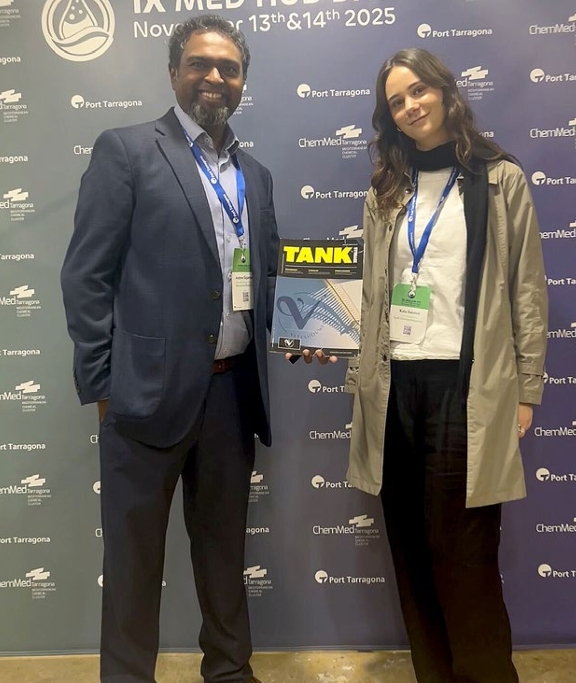
Andrew Sigamany, group advertising manager, and Kate Rainford, deputy editor, from the Tank Storage Magazine team
Day One: New Energies and Infrastructures
Genoveva Climent, commercial director of the Port of Tarragona, delivered the opening keynote ‘Becoming a new energies hub: challenges & opportunities’ and highlighted the strength of current liquid traffic at the port; 3.5 million tonnes of chemical products and 750,000 tonnes in hub-type operations in 2024. Climent emphasised the logistical and infrastructure challenges needed to make emerging projects a reality, especially new pipeline connections linked to H2Med and the transport of CO2 and H2. ‘The energy transition is no longer a distant scenario,’ she noted. ‘It is happening, here in Tarragona.’
The day continued with a presentation by Montse Espín, from Bureau Veritas, who analysed the current regulatory framework for maritime sustainability. She highlighted elements such as the ETS and FuelEU Maritime, as well as the uncertainty resulting from the postponement of new IMO regulations. Next, the roundtable ‘Ports of the future TALK: challenges for new energies flows’ featured Daniel Lorenzetto from Air Products, and Miguel Antonio Peña from AeH2. The discussion focused on the need for a clear regulatory framework with simplified permit procedures, solid EU definitions of renewable hydrogen, and long term policies. The session reinforced the role of the Port of Tarragona as a strategic mode for both exporting and importing these new products.
Day Two: Global Markets and New Opportunities
Day two’s sessions examined the future of petrochemicals, global logistics trends, and interaction between industry and research.
Luca Raffellini from S&P Global Commodity Insights opened with an analysis of the evolution of the European petrochemical sector, marked by a loss of production capacity to Asia and the Middle East. However, he noted that the Iberian Peninsula maintains a more stable position than other regions such as ARA or Italy. He also explained that energy and raw materials costs, and that key inputs into chemical supply are very high in Europe compared to the US. This is despite low crude prices, off-peak gas prices and green hydrogen projects. He also added that trade remains robust across chemicals, and that imports into Europe are increasing in major value chains such as ethylene, styrenics and methanol, and that demand is set to rocket in 2050.
Following Raffellini was Patrick Kulsen, CEO of Insights Global, who examined European logistics trends and their consequences for Mediterranean ports. Kulsen specifically looked at opportunities and threats at the Port of Tarragona, and noted that whilst there is a good rail system connecting Tarragona and North West Europe, and positive circumstances for production of low carbon fuels and feedstocks due to PV power being more affordable, there are increasing energy and regulatory costs in the EU, due to geopolitical uncertainties.
The connection between academia and industry took shape with a presentation by Fèlix Llovell, director of the URV-Repsol Foundation Chair in Energy Transition, who explained URV’s CCUS and hydrogen research projects. Llovell analysed CO2 capture, transport, and storage methods and their potential for producing synthetic fuels. José Ramón Freire, general director of the Spanish Association of Renewable Ammonia, outlined growth opportunities for the renewable-ammonia sector in Spain between 2025 and 2030, highlighting the key role the Port of Tarragona may play thanks to its experience and technical capacity.
The industry panel on CCUS featured Fran Sánchez from Dow Chemical, Fernando Impuesto from Enagás, and Francisco Pángaro from Repsol. The discussion focused on the TarraCO2 Project, led by Repsol with the participation of Dow. The project involves capturing CO2 from industrial facilities and transporting and storing it. The Port of Tarragona aims to become the essential maritime logistics node for the project, in line with international studies identifying Tarragona as a potential Mediterranean hub for captured CO2 flows.
The session closed with a presentation by Lourdes Vega, director of the R&I Center on CO2 at Khalifa University, who showcased renewable-molecule production projects underway in the UAE, Saudi Arabia, and Oman. Vega pointed out that nearly 80% of demand for these new molecules will come from Europe, Japan, and South Korea – creating significant opportunities for Mediterranean ports, especially the Port of Tarragona.
Key Takeaways
The two-day event made it clear that the port is still in a prime position to cater for the energy transition. The chemical and petrochemical industry in Tarragona currently achieves an annual production of 20 million tonnes, representing 50% of Catalonia’s production and 25% of Spain’s total production. With its strategic location and specialised infrastructure, allowing distribution of petrochemical products by sea, rail, road, or pipeline, the port continues to serve its local and global customers efficiently.
As Genoveva Climent mentioned in her opening speech: ‘The future of energy will be built on networks and collaborative projects, and the Mediterranean is offering a unique opportunity to lead the way.’