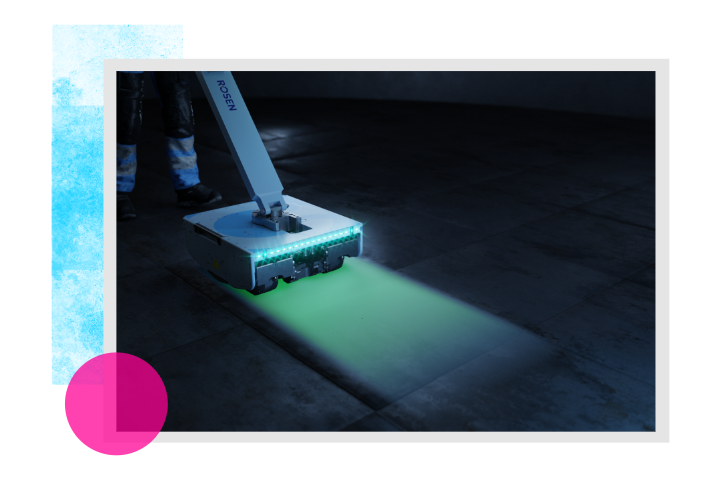


Arash Ilbagi, principal engineer and Richard Foecke, head of NDT products at ROSEN explain the new automated evaluation of ultra high-resolution MFL data
Tank bottoms are subject to constant mechanical stress and environmental exposure. Even minor degradation can compromise structural integrity. Traditional inspection methods often rely on manual interpretation and limited resolution, which can miss early-stage defects or underestimate their severity. This leads to conservative inspection intervals and reactive maintenance strategies, both costly and inefficient. Moreover, these traditional methods demand increased time inside the confined space for inspectors and contribute to longer operational downtime.
From Analog To AI
MFL technology (magnetic flux leakage), which remains the primary method for tank bottom inspections, has matured significantly since its analog origins in the 1960s. Early systems focused on basic corrosion detection, with manual readouts and limited sensitivity. The 2000s introduced digital sensors and multi-channel analysis, enabling more precise defect characterization.
Today, ultra-high-resolution MFL systems like ROSEN’s TBIT Ultra offer:
...
Redefining Tank Bottom Inspections: AI Driven Precision With TBIT Ultra